
SOLAR SOLUTIONS BUILT AROUND YOUR ENERGY NEEDS
Two ways to put your roof to work. Which one suits you depends on how reliable your grid supply is and whether you need power to keep running when it goes off.
01 / Grid connected
ON-GRID SOLAR
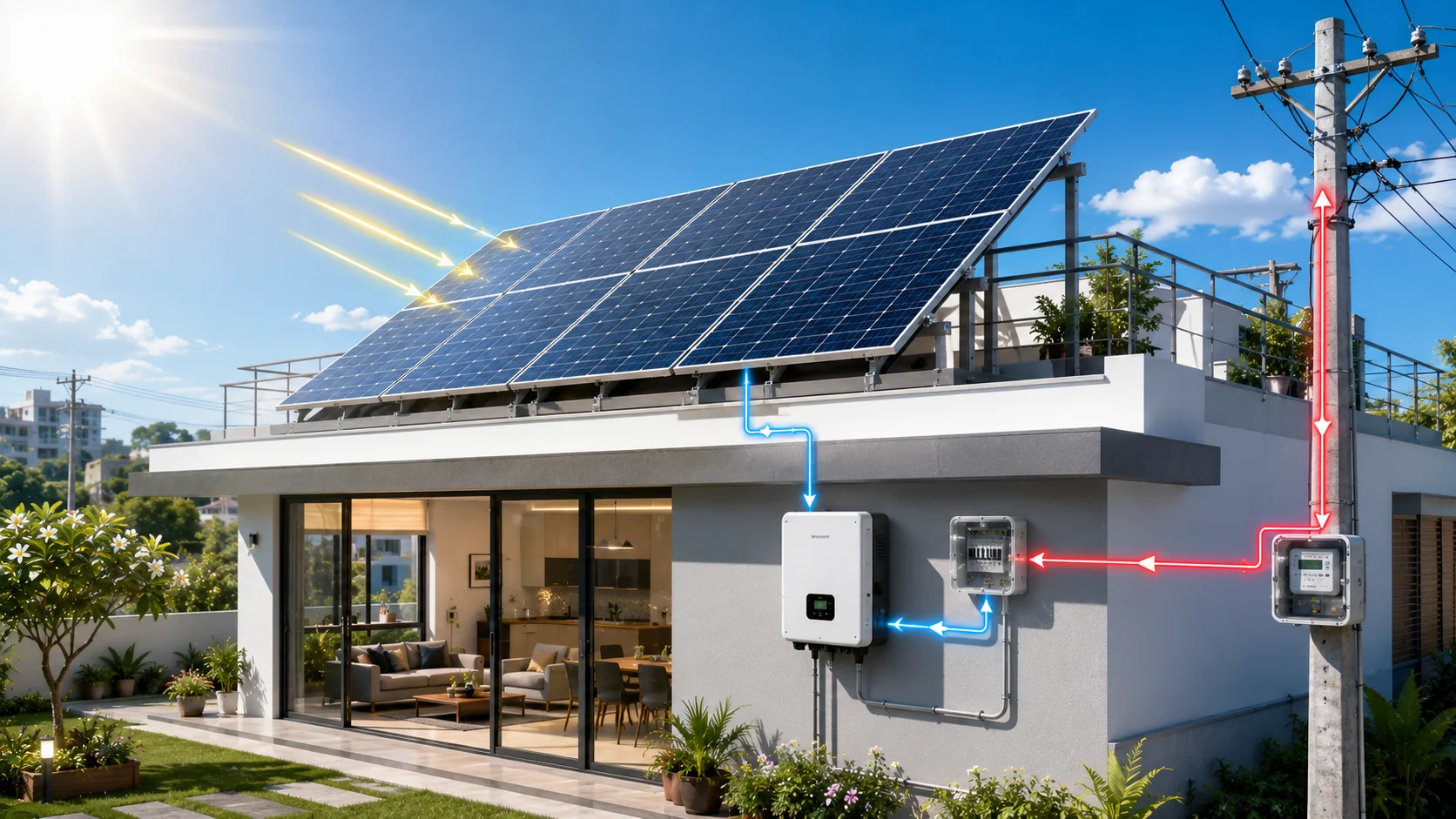
An on-grid system stays connected to the electricity grid, using solar power first and drawing from the grid when needed. Net metering allows any surplus power your system generates to be exported back to the grid, offsetting your electricity bill. It is a practical choice for homes and businesses looking to lower running costs without a battery.
The main components are the panel array, the mounting structure, a grid tied inverter, protection and metering equipment, and the cabling and earthing that tie them together. The inverter converts the direct current from the panels into alternating current at grid voltage and frequency, and shuts down automatically if the grid goes off, which is a safety requirement for anyone working on the line.
Net metering works on a simple principle. Your meter records what you import from the utility and what you export to it, and you are billed on the difference over the billing period. Rules, limits and approval steps vary by state and distribution company, so we confirm the current position for your connection in Odisha before finalising the system size.
SOLAR PANELS
→
INVERTER
→
PROPERTY
→
GRID
Suitable for homes and businesses with steady grid supply
Lower upfront cost than off-grid systems
Benefits from net metering where available
Main components: panels, inverter and metering equipment
02 / Battery backed
OFF-GRID SOLAR
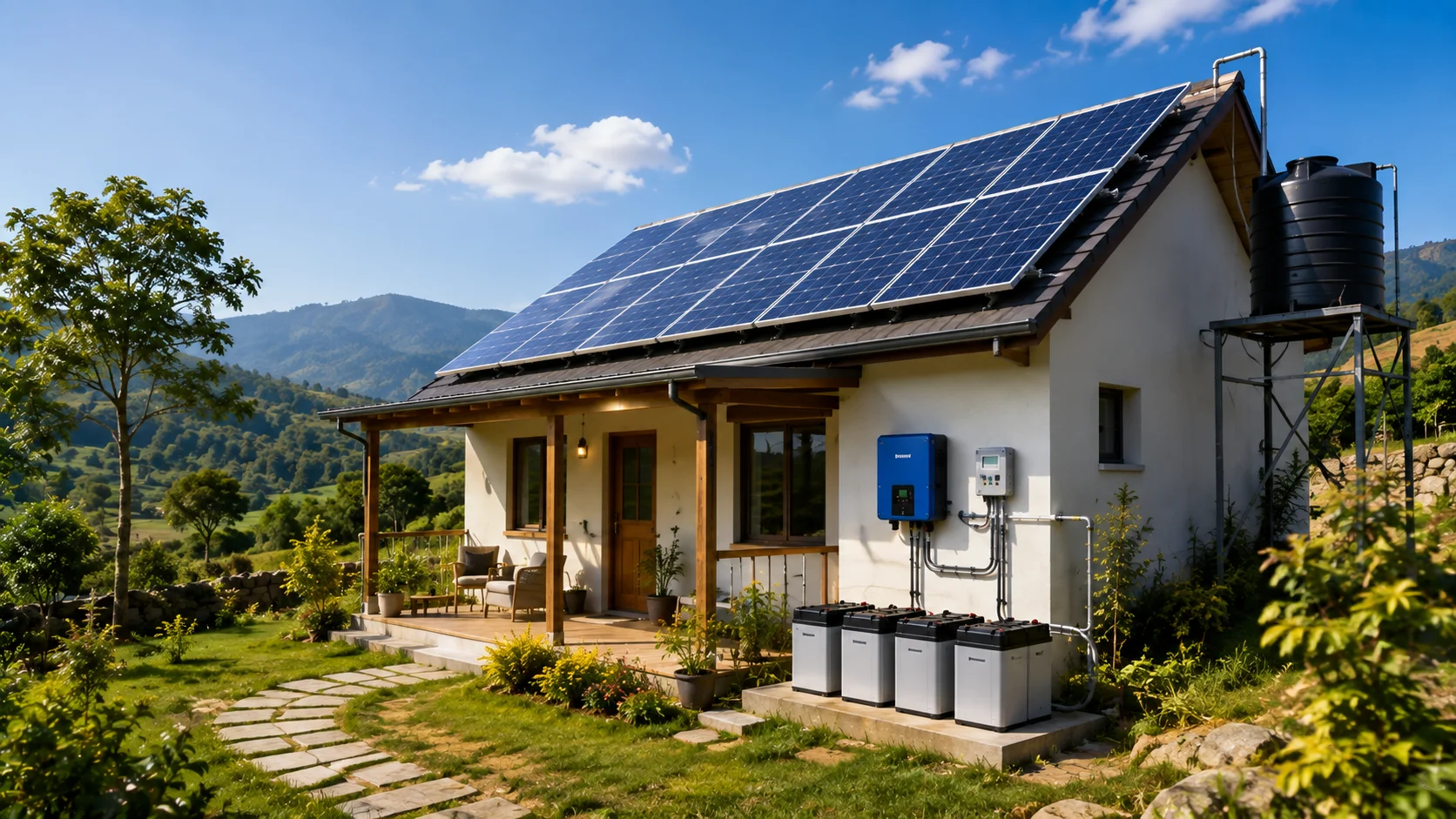
An off-grid system generates and stores solar power in batteries, giving power availability without depending on grid supply. It suits locations with unreliable grid power or properties seeking greater energy independence.
Generation from the panels is routed through a charge controller and an off-grid or hybrid inverter. Whatever your loads need at that moment is supplied directly, and the surplus charges the battery bank. When generation stops in the evening, or when the grid is down, the stored energy runs the loads you have chosen to back up.
Design here is about matching three things: daily energy consumption, how many hours of backup you want, and the loads that must stay live. Battery capacity is the expensive part of the system, so we usually recommend backing up essential circuits such as lighting, fans, pumps and refrigeration rather than the entire property.
SOLAR PANELS
→
INVERTER
→
BATTERY
→
LOADS
Battery storage provides backup during outages
No dependence on grid connectivity
Suited to remote sites and backup-critical loads
Main components: panels, inverter, battery bank
03 / Best of both
HYBRID SOLAR
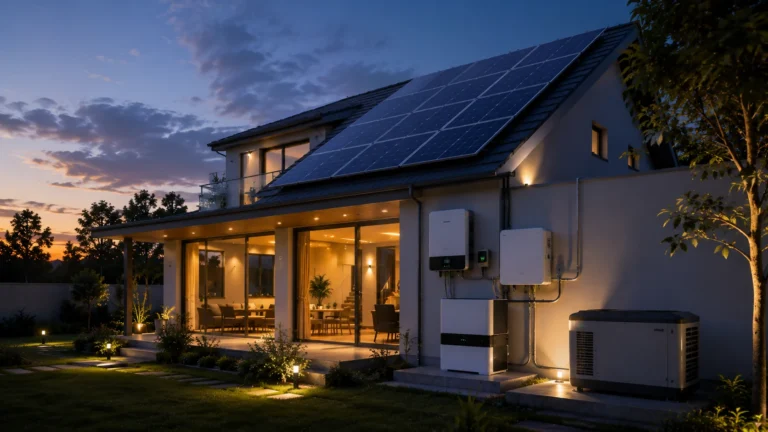
A hybrid system keeps the grid connection of an on-grid setup and adds a battery bank for backup. A single hybrid inverter manages all three sources: it runs your loads on solar during the day, charges the battery, exports or imports from the grid as required, and switches to stored energy the moment supply fails.
This is the practical choice for most Indian homes and small businesses. You get the bill reduction and net metering benefit of a grid tied system, and you also keep lights, fans, internet, pumps and refrigeration running through a power cut, without a diesel generator.
Sizing has two parts. The array is sized against your annual consumption, and the battery is sized only against the loads you actually want backed up and for how long. Keeping the backup list realistic is what keeps a hybrid system affordable, so we work that list out with you before quoting.
SOLAR PANELS
→
HYBRID INVERTER
→
PROPERTY LOADS
→
BATTERY & GRID
Bill savings plus backup from a single system
Automatic changeover, no manual switching during outages
Battery sized only for essential circuits to control cost
Works with net metering where the utility permits it
Main components: panels, hybrid inverter, battery bank, protection
04 / Water
SOLAR PUMPING SYSTEMS
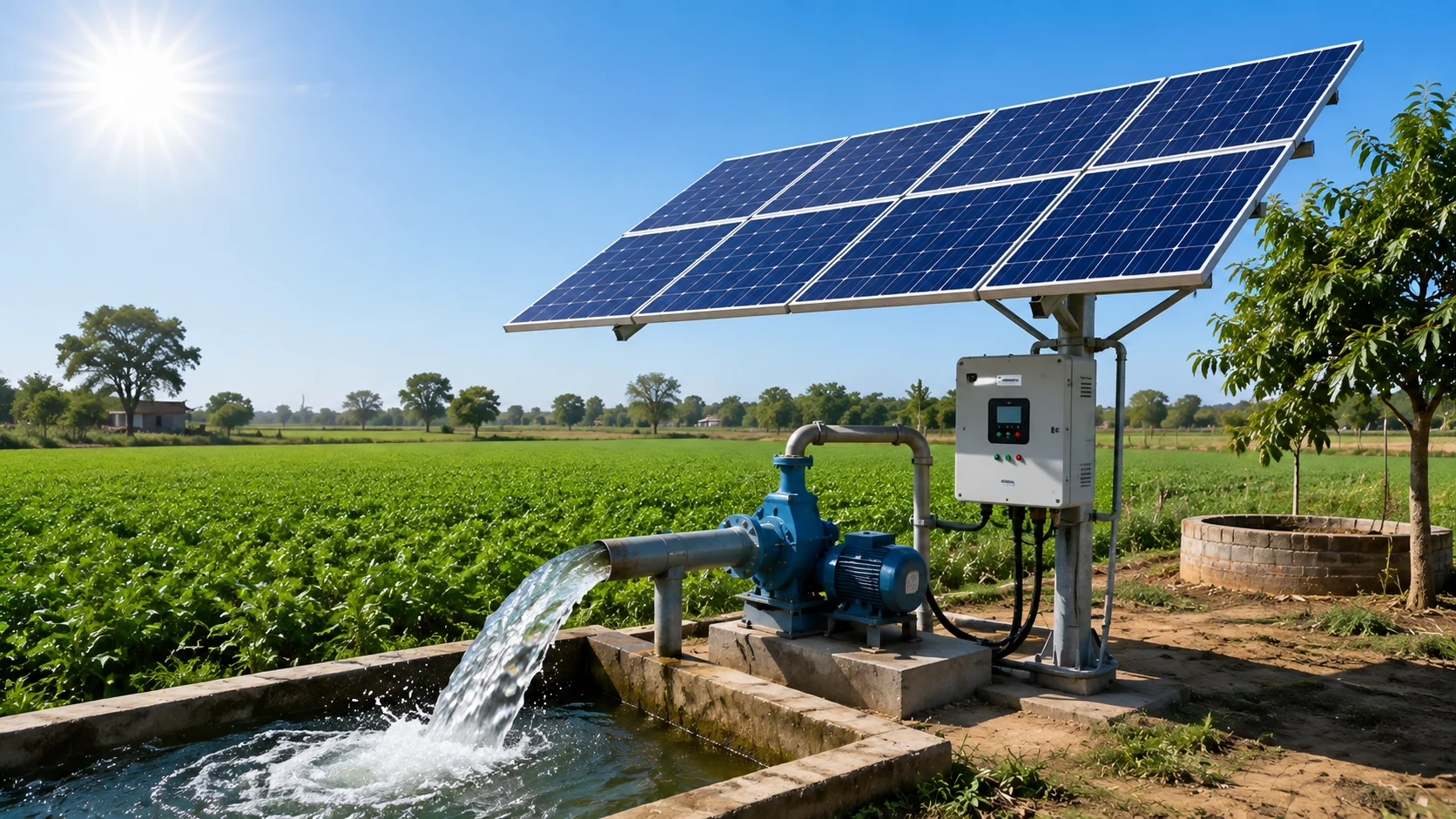
A solar pumping system runs a water pump directly from solar power. Panels feed a controller or variable frequency drive, which drives a surface or submersible pump. There is no battery in most designs, because the water tank itself stores the energy: you pump when the sun is available and use the water when you need it.
These systems suit irrigation, borewells, drinking water supply, farm and dairy use, and water lifting for housing societies. For sites where diesel pumpsets are used today, the running cost drops to almost nothing once the system is installed, and there is no fuel to carry to the field.
Design depends on three numbers: total head in metres, daily water requirement in litres, and the water level in your source through the year. From those we select pump type and rating, panel capacity, and pipe sizing. Dry run protection, level sensing and remote monitoring can be added where the pump is unattended.
SOLAR PANELS
→
CONTROLLER / VFD
→
PUMP
→
TANK OR FIELD
Surface and submersible options, AC or DC pumps
No fuel cost and no diesel handling at site
Tank storage removes the need for a battery bank
Dry run protection and level sensing available
Sized on head, daily water demand and source water level
05 / Outdoor lighting
SOLAR STREET LIGHTS
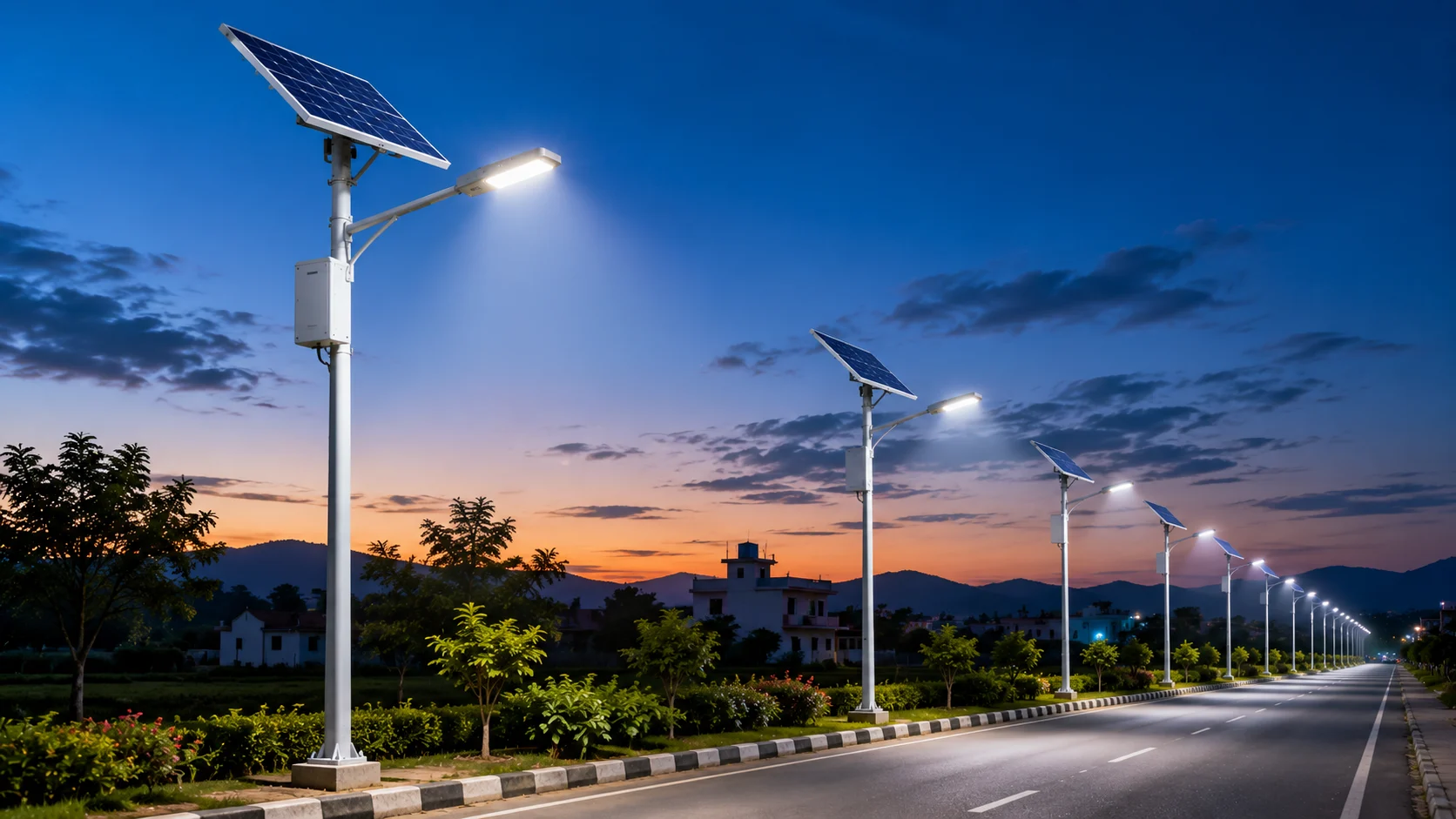
A solar street light is a self contained unit: panel, battery, charge controller, LED luminaire and pole. It charges through the day and lights the road from dusk to dawn with no cabling, no trenching and no electricity bill. Because each pole is independent, a failure at one point does not darken the whole stretch.
We supply both all in one integrated fixtures, where everything sits in a single housing, and split systems with a separately mounted panel and battery box, which suit higher wattages and partly shaded locations. Motion sensing can hold the light at reduced output and raise it to full brightness when someone approaches, which stretches battery autonomy through cloudy weeks.
Selection is based on the width of the road, required light level, pole height, spacing between poles and how many days of autonomy you want without sun. Typical use includes society internal roads, campuses, factory boundaries, parking areas, village roads and approach paths.
SOLAR PANEL
→
CHARGE CONTROLLER
→
BATTERY
→
LED LUMINAIRE
No trenching, cabling or metered supply required
Automatic dusk to dawn operation with optional motion dimming
All in one and split configurations for different wattages
Long life LED optics with lithium battery options
Poles, foundations and installation handled by our team
06 / Compact lighting
SOLAR DUSK LIGHTS
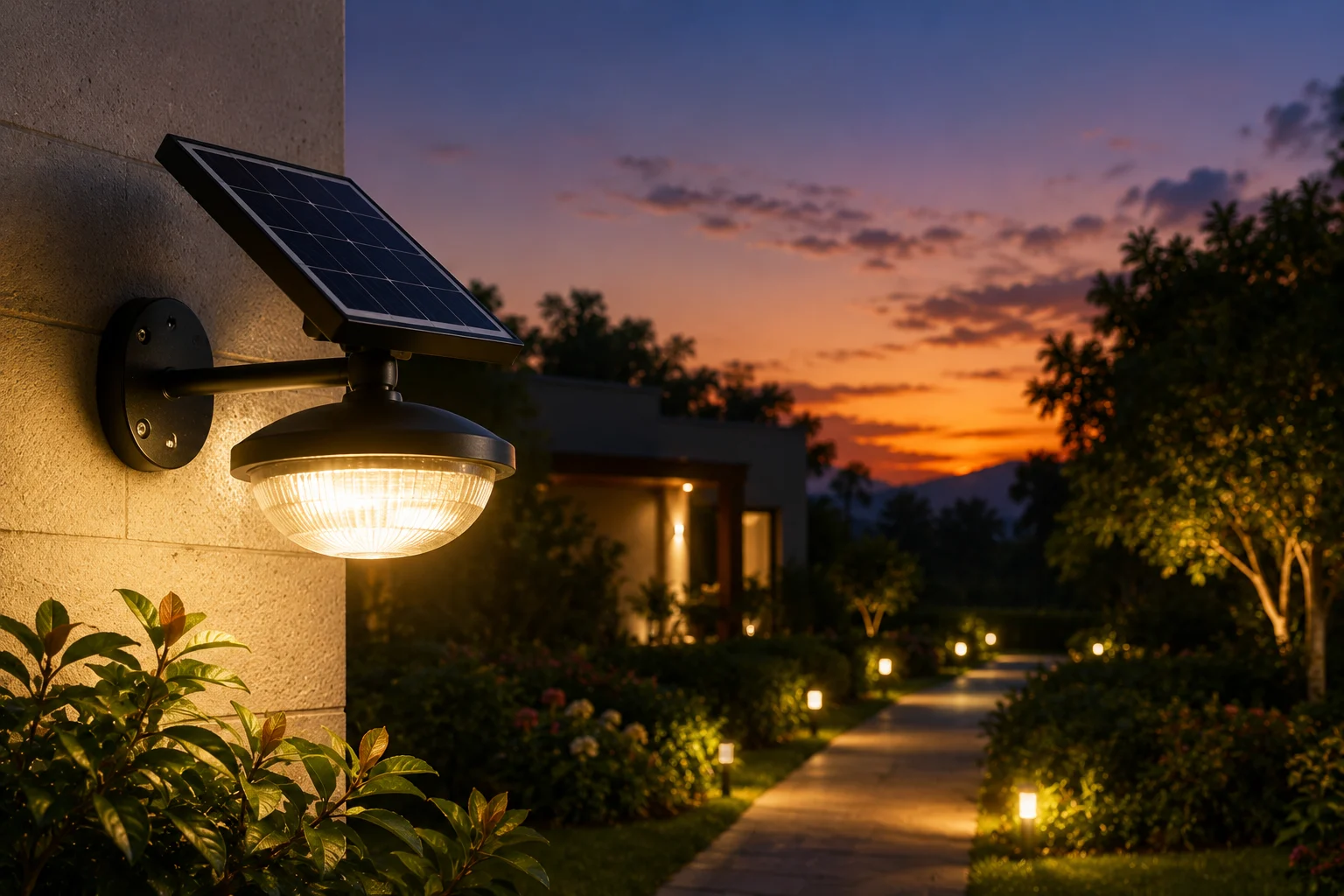
Dusk lights are small automatic solar lights for gates, courtyards, boundary walls, staircases, farm sheds, cattle sheds and shop fronts. A built in light sensor switches the fixture on as daylight fades and off again at dawn, so nobody has to remember a switch.
Each unit carries its own panel, lithium battery and LED module, so installation is a wall or pole mount with no wiring back to the meter. They are useful where running a cable is expensive or impractical, and where you want basic security lighting that keeps working during a power cut.
We help you pick output and quantity based on the area to be covered and how much of the night you want lit, and we position units so the panel gets clear sun without a tree or parapet shading it by afternoon.
Fully automatic dusk to dawn operation
Self contained panel, battery and LED in one fixture
No wiring, no meter connection, no running cost
Keeps working during grid outages
Suited to gates, walls, sheds, courtyards and shop fronts