
Getting the size right is the one decision that affects everything else: your price, your payback, your subsidy and whether your net metering goes through without an argument. It is not complicated, and you can do most of it yourself with an old electricity bill and a tape measure.
Start with your bill, not your roof
People start by looking at how much empty roof they have. That is backwards. The right size is the one that matches what you consume, and your roof only tells you whether that size will fit.
Pull out your last twelve months of bills if you have them, or at least the last three. On a TPNODL bill the number you want is the units consumed for the billing period, not the rupee amount. Add up the units across the months you have and divide by the number of months. That is your average monthly consumption.
Twelve months matters because a north Odisha house in May and the same house in December are two different customers. If you only have summer bills you will oversize. If you only have winter bills you will undersize and be disappointed in April.

Turning units into kilowatts
Here is the arithmetic I use. Odisha gets roughly 4.5 to 5 peak sun hours a day, and after real world losses I plan on about 4 units per kW per day. Over a month that is roughly 120 units per kW.
So: your average monthly units, divided by 120, is roughly the system size in kW.
- 250 units a month, about 2 kW
- 360 units a month, about 3 kW
- 600 units a month, about 5 kW
The PM Surya Ghar portal publishes a similar guide: 0 to 150 units suits 1 to 2 kW, 150 to 300 units suits 2 to 3 kW, and above 300 units suits above 3 kW. It is deliberately conservative. My figure of 120 units per kW is what I have seen on roofs in Mayurbhanj, and I would rather quote you something I can stand behind in year two.
Should you size for 100% of your consumption? Usually a little under. Covering roughly 80% gets you most of the saving without paying for capacity that spills into the grid at a rate you do not control.
How much roof you need
With the panels commonly used now, plan on about 70 to 80 square feet of clear, shadow-free roof per kW. That already allows a little room to walk between rows for cleaning.
- 2 kW: roughly 150 square feet
- 3 kW: roughly 220 to 240 square feet
- 5 kW: roughly 380 square feet
Measure the usable area, not the whole slab. Water tanks, staircase headroom, parapet shadow and the dish antenna all take space out of the middle of a roof. A 400 square foot terrace with a tank in the centre often gives you less than a clean 250 square feet.
Which way the panels should face
True south, tilted at roughly 20 to 22 degrees for our latitude. That is the best annual output for north Odisha, and on a flat concrete roof there is no reason to accept less, because the mounting structure sets the angle regardless of how the roof sits.
On a sloped or tin roof you work with what the roof gives you. South-east or south-west costs you a few percent and is perfectly acceptable. Due east or due west costs more, in the region of 15 to 20% over a year. Due north is not worth doing.
If the only clear space faces east, say so early. It changes the size you need for the same output, and it changes the payback figure. Better to know at the quote stage.
Shading is worse than people think
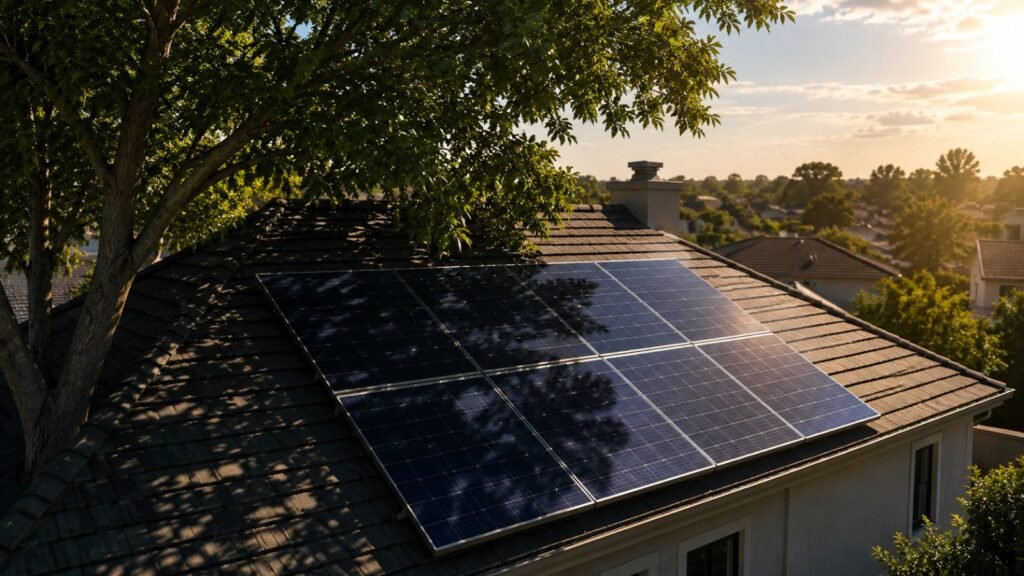
Panels in a string behave a bit like a queue. Shade on one panel drags down the ones connected with it, so a single branch across a corner can cost far more than the area it covers.
Walk your roof three times on a clear day: mid morning, noon, and about four in the afternoon. Note where shadows fall. The usual culprits around here are a neighbour’s water tank, a coconut or mango tree, the stair block on your own roof, and a wall that has planning permission to grow another floor.
That last one is worth asking about. A neighbour’s future first floor can put your afternoon generation in shadow for the next twenty years. It is an awkward conversation, but it is cheaper than moving an array.
Sanctioned load, and why oversizing causes problems
This is where good sizing turns into an approval problem. Your rooftop system has to sit within the sanctioned load on your electricity connection. MNRE issued an advisory in March 2026 telling DISCOMs to check sanctioned load and permitted inverter AC capacity before clearing net metering.
In plain terms: if your connection is sanctioned at 2 kW and you install 4 kW, your net metering application can be held up, and without net metering there is no commissioning certificate and no subsidy.
The fix is simple if you do it in the right order. Apply to enhance your sanctioned load first, get it done, then size the system. In our area that means an application to TPNODL, which covers Mayurbhanj, Balasore, Bhadrak, Keonjhar and Jajpur.
The good news for a normal household: Odisha allows net metering from 1 kWp to 500 kWp, and since 2 July 2024 the OERC no longer requires a technical feasibility study for systems up to 10 kW. A house-sized system sits comfortably inside both limits.
A worked example
A family in Baripada, twelve months of bills averaging 430 units a month, bill around ₹2,400. Flat concrete roof, about 500 square feet, water tank in one corner, stair block on the north side.
- 430 divided by 120 is about 3.6 kW. Sizing for roughly 80% of consumption points at 3 kW.
- 3 kW needs about 230 square feet. After the tank and the stair block, roughly 300 square feet is clear and south-facing. It fits.
- Sanctioned load is 3 kW, so no enhancement needed.
- 3 kW also happens to be where the subsidy maxes out at ₹78,000.
Three kilowatts is the answer for a lot of houses in our area, and that is not laziness. It is where household consumption, normal roof space, typical sanctioned load and the subsidy cap all happen to meet.
Getting it right the first time
Undersize and you keep paying a bill you hoped to be rid of. Oversize and you pay for panels that earn less than the ones beside them, and you may run into the sanctioned load problem on top. Neither is fixed cheaply once the structure is bolted down.
Once you have a size in mind, the post on what rooftop solar costs in Odisha and how long it takes to pay for itself turns it into a price and a payback figure, and the subsidy walkthrough covers the claim.
If you would rather have someone check the shading and the roof area properly, send us twelve months of units through the Get a Free Quote page. We will size it against your actual consumption and tell you plainly if your roof is not suitable.