
The sales conversation ends at commissioning. The system then runs for the next twenty five years, and almost nobody explains what that actually feels like. Here is what changes, what to expect in monsoon, and the short list of things that genuinely need your attention.
How your bill changes with net metering
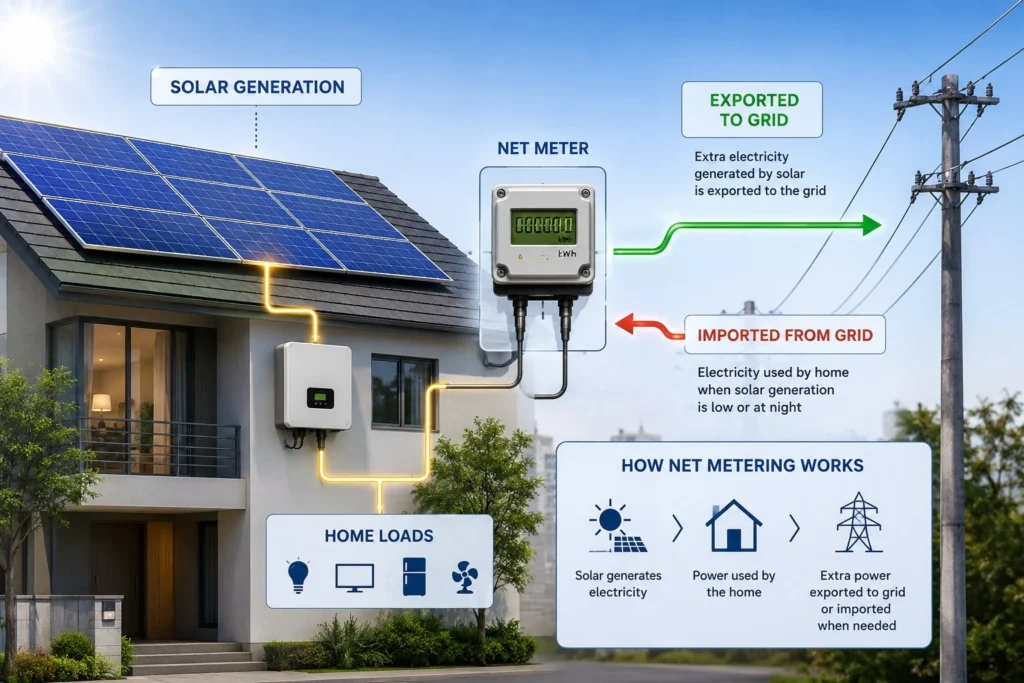
Your old meter counted units flowing in. The net meter counts both directions. During the day, when the panels make more than the house is using, the surplus goes out to the grid and is credited to you in units. At night you draw from the grid as usual.
The important part: you are credited in units, not rupees. Export units offset import units, and unused credit carries forward. This is why sizing for roughly 80% of your consumption makes sense. You want the solar to displace the electricity you buy, rather than banking a large surplus.
Odisha permits net metering from 1 kWp up to 500 kWp or your sanctioned load, so a household system sits well within it.
The first bill will confuse you, and that is normal
Two things surprise people. The first is that the bill does not go to zero. Fixed charges, meter rent and any duties are still payable. What solar removes is the energy charge, which is the large part, not all of it.
The second is timing. The net meter is often installed part way through a billing cycle, so the first bill covers a period that is half old arrangement and half new. Do not judge anything by it. Wait for two or three full cycles before deciding whether the system is performing.
Learn to read the import and export figures on the bill. Those two numbers, month on month, tell you more about your system than anything else you will be shown.
Monsoon and winter dips
Generation is not the same every month, and that is the thing people are least prepared for.
Through July and August, in a heavy monsoon week, output can sit 30 to 40% below your annual average. Some overcast days produce very little. This is not a fault, and calling your installer in the third week of July because generation is down is, nine times out of ten, a wasted trip for both of you.
Winter is a different pattern. December and January have clear skies but short days and a low sun angle, so output runs modestly below the yearly average. It is a gentler dip than monsoon.
The best months here are usually February to April: long days, strong sun, and not yet the worst of the heat. Peak summer is interesting. Panels lose a little efficiency as they get hot, so a 45 degree afternoon in May generates less than the same sunshine in March. That is physics, not a defect.
Judge your system on a full year, not a month. That is what the annual figures in the cost and payback post are built on.
Cleaning
Dust costs you more than people expect. A visibly dirty array can run several percent down, and in the dry months before monsoon it builds quickly.
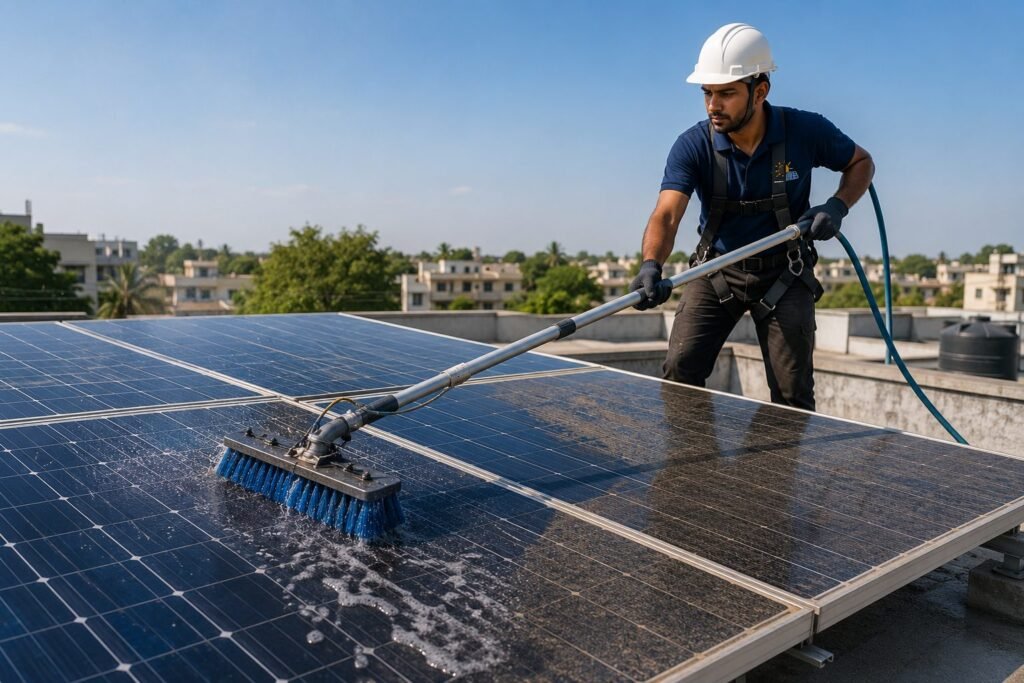
Through the dry season, plan on a wash every two to four weeks. During monsoon the rain does most of it and you can leave it alone, though it is worth a look after a dust storm.
- Wash early morning or late evening, never on a hot panel in the middle of the day
- Plain water and a soft brush or cloth. No detergent, no scouring
- Never a hard jet at the panel edges, where the seal is
- Watch your footing on a wet roof, and never stand on a panel
Cold water on a hot panel is the one genuinely damaging mistake. The thermal shock can crack a cell. Early morning is safest for that reason alone.
Bird droppings deserve a mention. Unlike dust, a dropping is opaque and concentrated, and a single one in the wrong place can drag down a whole string. Deal with those when you see them rather than waiting for the next wash.
Monitoring your output
Most inverters sold now have an app or a web portal. Get it set up on the day of commissioning, while the installer is still standing there, and make sure it is on your phone and not only on theirs.
You do not need to watch it daily. A glance once a week is plenty. What you are looking for is a change in pattern rather than an absolute number: a sudden drop on a clear day, one string producing noticeably less than the other, or a day with no generation at all.
Write down your monthly total somewhere. After a year you will have a baseline for your own roof, and comparing this March to last March is far more useful than comparing your system to your neighbour’s.
What needs attention over 25 years
The honest answer is: not much, but not nothing.
- Every year, before monsoon. Check the structure for rust, especially at joints and bolt heads. Check that fixings are still tight. Check the earth pit. Check that cable clips have not perished and nothing is hanging loose.
- Every year or two. Have the DC connectors checked. Loose or degraded connectors are a common cause of a string underperforming, and they are a fire risk if left.
- Around year 10 to 12. Expect to replace the inverter. Budget ₹25,000 to ₹40,000 for a 3 kW unit. This is normal and should be planned for, not treated as a failure.
- Continuously, in the background. Panels degrade slowly, in the region of half a percent a year. Most carry a performance warranty of roughly 80% output at 25 years.
- As the trees grow. Shading that did not exist at installation appears over the years. Keep branches trimmed back.
That is the whole list. Rooftop solar has no moving parts, which is precisely why it is worth doing.
When to actually call someone
Call if generation drops sharply on clear days and cleaning does not fix it. Call if the inverter shows a fault code, or is off when the sun is up. Call if you see scorching, discolouration or melted insulation anywhere. Call if a panel is visibly cracked or has moisture inside the glass. Call after any serious storm, even if everything looks fine from the ground.
Do not call because output is low in monsoon week. That one is the weather.
Living with it
After the first year most people stop thinking about the system entirely, which is the correct outcome. It sits there, the bill is smaller, and once a month somebody goes up with a bucket.
The households that stay happy are the ones who were told the truth at the start: about the monsoon dip, about fixed charges still appearing on the bill, and about the inverter needing replacement one day. None of that changes whether solar is worth doing. It just means nothing arrives as an unpleasant surprise in year three.
If you are still at the deciding stage, the posts on sizing and on what separates a good installation from a bad one are the two worth reading first.
And if you already have a system that is not behaving, or you want one installed by people who will still answer the phone in year six, get in touch through the Get a Free Quote page. We cover Mayurbhanj and north Odisha.