
Two 3 kW systems can look identical from the road and be ten years apart in how long they last. The difference is almost never the panels, because everyone buys from a similar shortlist. It is the structure, the cable, the earthing and the care taken on the day.
The mounting structure is where money gets quietly saved
If a quote is unusually cheap, look here first. It is the easiest place to cut and the hardest for a customer to judge from the ground.
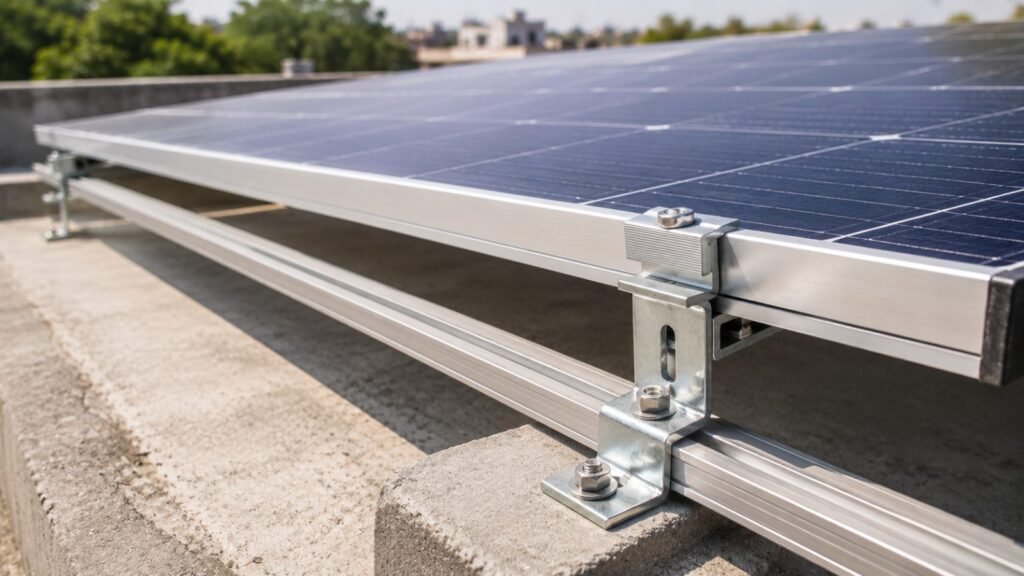
What you want is hot-dip galvanised steel, not mild steel angle with a coat of paint on it. Painted MS looks fine on day one. In coastal and near-coastal Odisha, with salt in the air and three months of monsoon every year, it starts showing rust at the welds inside two or three years. Once the structure goes, moving a live array to replace it costs more than the structure ever did.
Ask what the galvanising thickness is. Ask whether the structure is bolted or welded on site, because site welds burn off the galvanising unless they are treated afterwards. Ask how it is anchored to the roof. Chemical anchors into the slab, not a lump of cement holding a leg down.
Wind matters here more than in most of India. North Odisha gets serious wind, and Balasore and Bhadrak get cyclone-grade wind. The structure should be designed for the wind zone, with the array high enough off the slab for air to move under it and not so high that it becomes a sail.
Cable and protection sizing
Undersized cable is invisible and expensive. It shows up as generation that is quietly 5% lower than it should be, and as cable that runs warm for twenty years.
DC cable on the roof should be proper solar cable: UV resistant, double insulated, rated for outdoor life. Ordinary house wiring on a roof in Odisha sun will go brittle and crack. Run it in conduit or tray, clipped down, not draped across the slab where it will be walked on.
On protection, a proper installation has all of this and a cheap one has some of it:
- A DC isolator between array and inverter, so the array can be switched off
- DC surge protection
- An AC MCB correctly rated for the inverter output
- AC surge protection
- Residual current protection on the AC side
Surge protection gets skipped constantly because nothing goes wrong until the day it does. We get lightning through the pre-monsoon and monsoon months. An inverter is the most expensive single component after the panels, and a surge device costs a fraction of replacing one.
Earthing
This is a safety item, not a performance one, and it is the thing I check first on any system I am asked to inspect.
The array frame needs earthing. The inverter needs earthing. If there is a lightning arrestor, it needs its own earth. These should be proper earth pits, and the installer should measure the earth resistance and tell you the reading rather than assuring you it is fine.
What I see on bad jobs is a single earth wire from the frame tied into the house earth, or an earth pit dug and filled with whatever was on hand. In our soil, and with the water table moving as much as it does between May and September, a badly made pit reads acceptably in monsoon and badly in April.
Where the inverter goes
Inverters are electronics and heat shortens their life. Mounted on a south wall in direct sun is the most common mistake I come across, and it will take years off a unit.
Put it somewhere shaded and ventilated, with clear air around it, at a height where the display can be read without a ladder. Not sealed inside a cupboard. Not in a damp corner. Close enough to the meter to keep the AC run short, and reachable for service without dismantling anything.
ALMM, DCR and BIS
For a subsidised system this is not optional. Panels must be from the approved list and meet the domestic content requirement of the scheme. Panels that are not compliant can cost you the entire subsidy after you have already paid for the system, which is one of the most common reasons claims fail.
Ask for the make and model in writing on the quotation, and check the module serial numbers against the delivery when the panels arrive. Do the same for the inverter. A quotation that says “540 W mono panels” with no manufacturer named is not a quotation, it is a placeholder, and what turns up on your roof is whatever was cheapest that week.
What you should be handed at the end
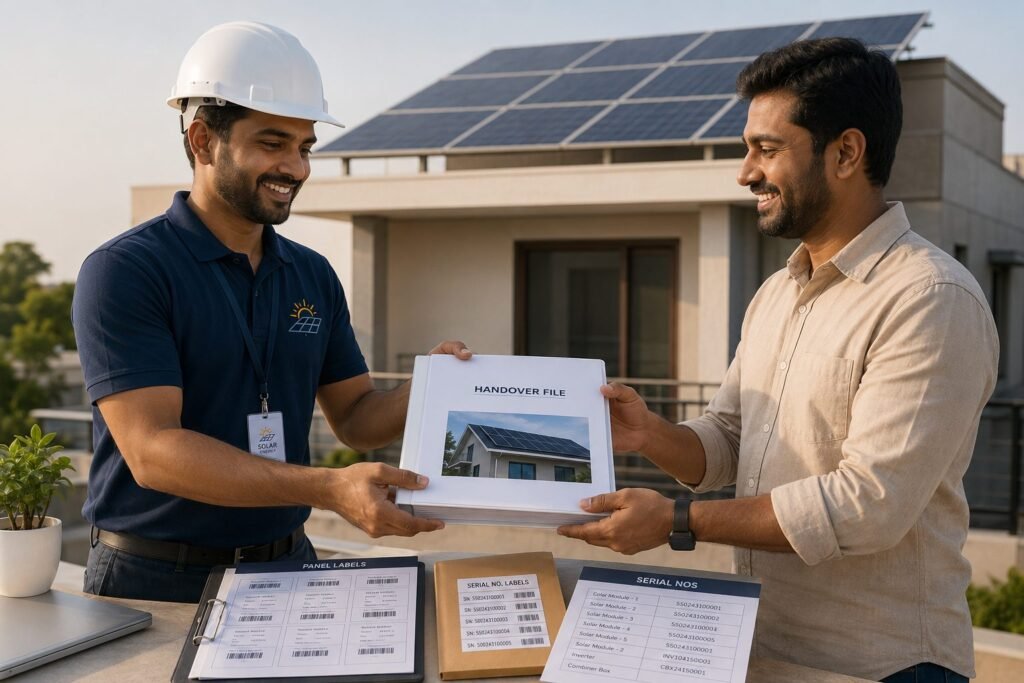
A finished job comes with a file. If your installer walks away with nothing more than a handshake, you have no way to claim a warranty in year eight.
- Panel warranty certificates, with serial numbers that match your roof
- Inverter warranty certificate and the registration, if the brand requires one
- Datasheets for panels, inverter and cable
- A single line diagram of your system as actually built
- Earth resistance readings
- The net meter test report and the commissioning certificate from the portal
- Monitoring login details, if the inverter supports it
- A written maintenance schedule and who to call
Keep this file with your property papers. In fifteen years you will not remember which inverter you bought, and if you ever sell the house it is worth having.
Warning signs of an install that will cost you later
- No site visit before the quote. Nobody can price a roof they have not stood on.
- A price with the subsidy already deducted. The subsidy comes to your bank account after inspection. It is not a shop discount, and anyone presenting it as one is hiding how the money moves.
- No brand names on the quotation. See above.
- Panels laid flat on the slab or on a few bricks. No tilt, no airflow, no structure worth the name.
- Installation starting before DISCOM approval. If the approval comes back different, the rework is at your cost.
- The installer is not registered on the national portal. Then there is no subsidy, whatever you were told.
- No mention of earthing or surge protection anywhere in the quote.
The gap between a careful installation and a careless one on a 3 kW system is maybe ₹15,000 to ₹25,000 at the quotation stage. Set that against a system meant to run for 25 years and it is not a close call.
Questions worth asking before you sign
You do not need to be an engineer. Ask what the structure is made of and how it is anchored. Ask what earthing you are getting and what reading they expect. Ask for makes and models in writing. Ask what documents you will be handed on the last day. An installer who answers those four clearly is usually doing the rest properly too.
Once it is running, the post on what to expect after commissioning covers the maintenance side, and the cost and payback post explains where a suspiciously low quote is finding its savings.
If you have a quote in front of you and you are not sure what you are looking at, send it to us through the Get a Free Quote page. We will tell you what is missing from it, even if you go on to buy from someone else.